.png)

Redirecting Misbehavior: Turning “Mine!” into Moments of Learning

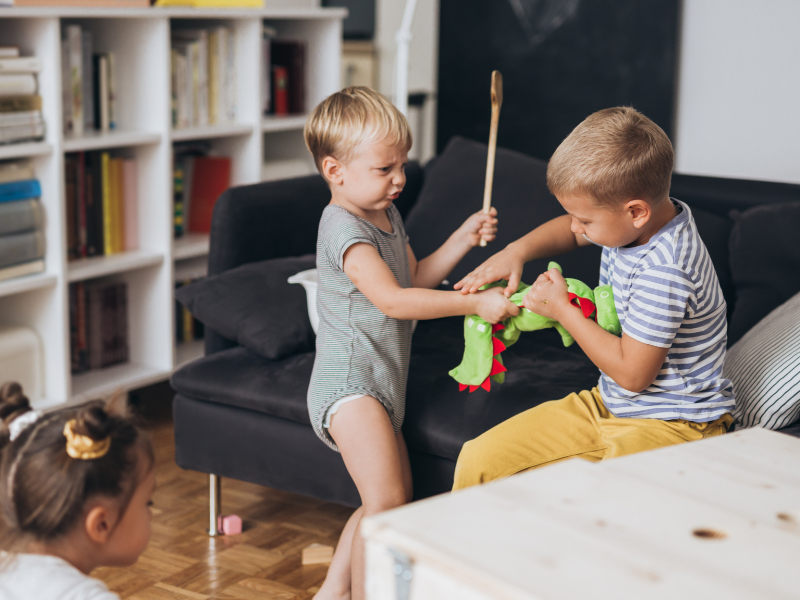
If you’ve ever watched two toddlers wrestle over the same toy, you know just how quickly playtime can turn into a full-blown battle. Little hands grab, voices rise, and before you know it, tears are flowing. As a parent, teacher, or caregiver, it can feel tempting to step in with the classic command: “Share!”
But here’s the catch: for very young children, especially those under three, the concept of sharing isn’t something they can fully understand yet. Their brains just aren’t wired for that kind of abstract reasoning. That doesn’t mean they’re selfish; it simply means they’re still learning how the world works.
So, what’s a grown-up to do in these tricky moments? The answer lies in a simple, gentle strategy: redirecting misbehavior.
Distraction: A Lifesaver for Toddlers
For the youngest children, distraction works like magic.
Let’s say two toddlers are locked in a tug-of-war over a shiny toy truck. Instead of repeating, “You need to share,” (which usually falls on deaf ears at this age), try shifting the focus.
👉 “Look at this red car! I bet it can go really fast. Do you want to try it?”
Suddenly, the tension melts. The second toy becomes the new point of interest, and the conflict fizzles before it spirals into tears.

This isn’t bribery or avoidance, it’s a developmentally appropriate way to manage situations that toddlers aren’t yet equipped to handle. By gently guiding their attention elsewhere, you create peace while also showing them that there are always more options than fighting.
Growing Up Means Growing Skills
Of course, redirection isn’t the end goal. As children get older, say, three, four, or five, they start developing the ability to reason, wait, and problem-solve. At this stage, constantly swooping in with a shiny distraction robs them of the chance to learn critical social skills.
This doesn’t mean leaving them to hash it out on their own, though. Instead, you become a coach, guiding, encouraging, and helping them find their own solutions.
Practical Ways to Guide Older Kids
When preschoolers argue over the same toy, you can gently step in with ideas that put the power in their hands:
Play Together: Suggest combining efforts. “Maybe you could race the truck back and forth, what do you think?”
Take Turns: Offer a timed approach. “How about you use the truck for five minutes, and then it’s your friend’s turn?” (Yes, this sometimes requires a timer and a little supervision.)
Add a Twist: Bring in a second toy and encourage them to create a game. “What if the truck delivers blocks to the car? Could they work together?”
Instead of simply solving the problem for them, you’re modeling problem-solving strategies they can eventually use on their own.
The Power of Validation

In the heat of a squabble, kids often feel unheard. One of the most powerful tools you can use is acknowledgment.
Try saying something like:
👉 “I see you both really want to play with this truck. It’s hard to wait your turn, isn’t it?”
That simple validation does wonders. It helps children feel understood while diffusing frustration. Once their feelings are recognized, they’re far more willing to listen to solutions.
Reinforcing the Wins
Here’s the part many adults overlook: celebrating the victories.
When a child finally shares or takes turns, don’t let it pass unnoticed.
Shine a spotlight on it:
👉 “That was so kind of you to let your friend have a turn! You’re being such a good friend.”
Positive feedback reinforces the idea that cooperation feels good, not just for others, but for themselves. And the more they hear it, the more they’ll internalize it as part of who they are.
Redirecting Misbehavior: More Than a Tactic
At first glance, redirecting misbehavior looks like a quick fix for toddler tantrums. But in reality, it’s much more than that. It’s about:
Meeting children at their developmental level.
Giving toddlers tools to avoid conflict before they’re ready to reason.
Coaching older children into becoming thoughtful problem-solvers.
Creating a foundation of empathy, cooperation, and respect.
By shifting from “command and demand” to “guide and support,” we’re teaching kids lifelong skills: how to handle conflict, how to compromise, and how to consider others.
A Final Thought
Sharing is hard. Taking turns is hard. Waiting is hard. But these challenges aren’t signs of bad behavior, they’re opportunities for growth.
For toddlers, distraction and redirection can keep the peace while protecting friendships. For older children, gentle coaching and problem-solving build the social muscles they’ll need for school, relationships, and beyond.
So the next time you hear the familiar cry of “Mine!” remember: this is your moment to guide, not with lectures or scolding, but with redirection, empathy, and encouragement. Over time, those small moments add up, and you’ll see your child blossoming into a cooperative, kind, and capable human being.
And that’s a win worth celebrating.
If moments like these feel familiar, you’ll love our piece on handling stubborn behavior without power struggles


Comments